OFFICE INSIGHTS · PLAZA SENTRAL, KL SENTRAL
Buying or Renting a Plaza Sentral Office: A Practical Comparison
By Ho Chin Kun (REN 06503), One WSM Property Sdn Bhd · E(1)1823
Published · Indicative 2026 working figures
For a business expecting to stay in KL Sentral for many years, an office purchase deserves a closer look. This guide compares renting with a purchase financed using a 20% down payment and an 80% loan over 20 years at an illustrative 4.5% annual interest rate. The decision combines monthly cash flow, equity built through repayment and workplace continuity.
Start with like-for-like 2026 figures
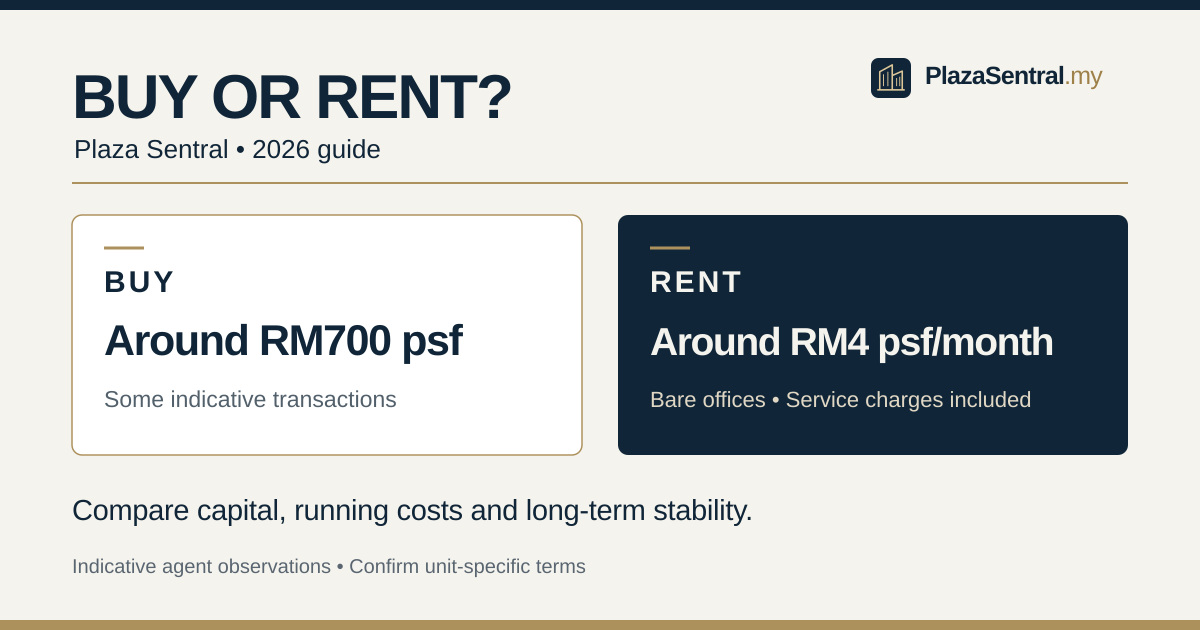
Ho Chin Kun’s indicative market observations put some Plaza Sentral transactions around RM700 per sq ft, with bare-office rents around RM4 per sq ft per month or slightly below. These are agent-supplied working benchmarks, not an independently audited transaction series or a valuation of every office.
| Item | Indicative assumption |
|---|---|
| Purchase price | RM700 per sq ft, based on some reported transactions |
| Bare-office rent | RM4 per sq ft per month; some units may be slightly lower |
| Owner’s maintenance charges | Approximately RM1.40 per sq ft per month |
| DBKL assessment | Approximately RM0.30 per sq ft per month as a budgeting equivalent |
Consistent with this website’s rental convention, the example assumes rent includes building service charges and assessment is borne by the landlord. Do not add maintenance again to the rental side. Check the actual tenancy, management bill and assessment notice, including whether sinking-fund contributions or insurance are within the quoted maintenance amount.
Assessment is expressed as a monthly equivalent for comparison; this does not describe its billing frequency. Confirm each unit’s area, condition, floor, title, tenure and possession terms.
A 2,000 sq ft mortgage-versus-rent comparison
At RM700 per sq ft, the purchase price is RM1,400,000. A 20% down payment is RM280,000, leaving an 80% loan of RM1,120,000. With monthly repayment over 20 years at a constant 4.5% annual interest rate, the instalment is approximately RM7,086 a month.
| Comparison point | Purchase cost / month Excludes principal | Rent / month | Purchase cash flow / month Includes principal |
|---|---|---|---|
| Initially | RM7,600 | RM8,000 | RM10,486 |
| After 5 years | RM6,873 | RM8,000 | RM10,486 |
| After 10 years | RM5,964 | RM8,000 | RM10,486 |
| After 15 years | RM4,825 | RM8,000 | RM10,486 |
| After 20 years · loan repaid | RM3,400 | RM8,000 | RM3,400 |
Purchase cost = interest + maintenance + assessment. Purchase cash flow = the full loan instalment + maintenance + assessment. The 5-, 10- and 15-year rows use the next payment after that many completed years; the 20-year row is after the loan has been repaid. Rent and running charges are held constant to show the effect of declining interest; actual rents and charges can change. These figures exclude purchase costs, repairs and other owner expenses.
FD opportunity cost: the RM280,000 down payment could earn about RM700 a month equivalent at an illustrative 3% annual FD return before tax. This foregone income is additional to the costs shown, rather than an extra cash bill; it is not a current bank offer or a statement that interest is paid monthly.
The mortgage purchase therefore needs approximately RM2,486 more cash each month than renting at RM4 per sq ft initially. At an inclusive rent of RM3.80 per sq ft, rent would be RM7,600 and the additional owner cash requirement approximately RM2,886 a month.
The RM280,000 down payment is additional to applicable stamp duty, legal work, valuation, financing expenses and fit-out. The monthly comparison excludes repairs, other owner charges and taxes. Electricity, connectivity, parking and other user expenses require a separate budget under either option.
This is a calculation scenario, not an available bank offer. It assumes a fully amortising loan with monthly payments and a constant rate throughout. Loan approval, financing margin, term, fees and actual rate changes depend on the borrower and property.
Understand purchase cost and equity built
The first RM7,086 instalment contains approximately RM4,200 interest and RM2,886 principal repayment. Principal reduces the loan balance and builds the owner’s equity. The company must fund the whole instalment, but treating all of it as an expense would overlook the debt being repaid.
On the stated figures, initial monthly interest plus maintenance and assessment is RM7,600, compared with RM8,000 rent. This separates financing and running expenses from the principal being repaid. It excludes purchase costs, repairs and other ownership expenses, so it is not a complete measure of ownership cost.
At the assumed constant rate, the RM7,086 loan instalment stays level while its interest share falls and its principal share rises as the balance is repaid. Lower interest therefore reduces the expense portion, rather than the scheduled monthly payment. Maintenance, assessment, repairs and rent can also change, so overall savings depend on the actual figures and holding period. Once all 240 scheduled payments have been made, this loan is fully repaid. Ownership charges and refurbishment continue, while the company retains the property subject to its title and tenure. Future resale value is uncertain.
A full long-term comparison should also account for the alternative use of the RM280,000 down payment and other committed capital, changes in rent and owner charges, and the property’s eventual resale value and selling costs. Renting initially uses less capital and offers more flexibility; ownership offers a path to a debt-free workplace.
WORK OUT YOUR NUMBERS
Try your own office mortgage comparison
Adjust the example to compare an office mortgage with rent. The starting figures use 20% down, 4.5% annual interest and a 20-year loan. All calculations are before tax.
- Initial purchase cost / month
- Rent / month
Purchase cost shown = interest + maintenance + assessment. Principal repayment is excluded. All calculations are before tax.
- Initial monthly interest
- Initial monthly principal repayment
Monthly purchase cost versus rent over time
| Period | Purchase cost / month (excludes principal) | Rent / month | Purchase cash flow / month (includes principal) |
|---|
Illustrative foregone FD return: /month equivalent on the down payment at a year before tax, additional to the purchase cost shown. It is foregone income, not a cash bill. The assumed return is not a current bank quote.
Initial monthly cash requirement
- Mortgage repayment
- Purchase cash flow · including principal
- Purchase price
- Down payment · before purchase costs
- Loan amount
- Maintenance / month
- Assessment / month
View the mortgage repayment split
| Payment milestone | That month’s interest | That month’s principal | Loan balance after payment |
|---|
The interest portion falls as the loan is repaid, strengthening the long-term cost case for ownership. At a constant rate the scheduled instalment stays level, with more going towards principal. Buying still requires the down payment and higher cash outflow in the starting example. Principal repays debt and builds equity; the full instalment needs funding. Owner outflow includes the mortgage, maintenance and assessment shown. Purchase costs, repairs, other owner charges, tax, utilities and the opportunity cost of committed capital are additional.
Illustration using monthly reducing-balance payments at a constant rate, rounded to the nearest ringgit. This is not a bank quote. Actual approval, rates and terms vary. Figures are calculated in your browser and are not sent or saved.
The long-term benefit: avoid paying to move again
If team size, location and technical requirements are likely to remain stable, ownership can support a longer useful life for a bespoke fit-out. A tenant may have to move if renewal terms cannot be agreed or the landlord requires possession, even where the present office still suits the business.
A move can involve more than the next office’s rental:
- A replacement fit-out, design work and approvals.
- Reinstatement of the old premises, where required by the tenancy.
- Movers, new cabling, internet migration and IT reinstallation.
- Overlapping occupancy costs while preparing the replacement office.
- Staff disruption, address changes, client communication and operational downtime.
Buying can reduce the risk of repeating these costs for lease-related reasons. An initial bare-office fit-out may still be required under either choice, and an owned office still needs maintenance and eventual refurbishment. Growth, downsizing or a change in business model can also make an owned unit unsuitable.
Lock in the acquisition price, not every future bill
Rent may also increase over a long holding period. At around RM4 per sq ft, the Plaza Sentral benchmark used here sits below selected advertised offices in Damansara Heights and Petaling Jaya. For context, JLL advertises Menara Milenium in Damansara Heights at RM6.80–RM7.50 per sq ft and The Ascent in Petaling Jaya at RM5.50 per sq ft, checked 6 November 2026. These are asking rents rather than achieved transactions; building grade, condition and lease inclusions differ, so they are context rather than exact equivalents.
This relative-value position is a reason to allow for possible rent increases in a long-term budget, particularly if demand strengthens. If rent rises while the loan’s interest portion declines, the ownership cost advantage can widen. For perspective, five hypothetical annual increases of 3% would take RM4 rent to approximately RM4.64 per sq ft. This is a scenario, not a rental forecast. Ownership removes rent-renewal exposure for that unit, while maintenance, assessment, repairs, special levies and a floating financing rate can also rise. Renting may remain attractive where flexibility or working capital matters more.
Check the property and the full commitment
- Space suitability: test the layout, reasonable growth allowance, access and technical needs over the intended holding period.
- Property position: have the relevant professionals check title, tenure, permitted use, possession, restrictions and unit-specific transaction evidence.
- Building finances: review management charges, sinking fund, insurance, arrears, planned works and possible special levies.
- Upfront budget: allow for applicable stamp duty, legal work, valuation, financing expenses, fit-out and an operating reserve.
- Exit options: assess resale liquidity and the practicality of letting the office if the business later changes its requirements.
Stamp duty needs a property-specific assessment. JPPH explains that transfer-duty valuation uses the consideration or market value, whichever is greater. Confirm the applicable duty, purchaser category and any relief with your solicitor rather than assuming duty is based only on the negotiated price.
Buying is most compelling when the premises suit a durable business need, the holding period is long and the capital commitment is affordable. Renting keeps more capital available and makes later changes easier. Compare current Plaza Sentral offices for sale with offices for rent, then apply the actual figures to your preferred unit.
Buying versus renting: common questions
Does buying a Plaza Sentral office lock in every occupancy cost?
Buying fixes the agreed acquisition price and removes exposure to rent renewals for that owned unit. Maintenance, assessment, repairs, special levies and financing costs can still change, so the total cost of occupation is not permanently fixed.
Is RM700 per sq ft a valuation for every Plaza Sentral office?
No. It is an indicative level reported by the agent for some transactions in 2026. A particular unit must be assessed using relevant transaction evidence, title and tenure, condition, size, floor and possession terms.
Can ownership reduce future relocation and fit-out costs?
It can reduce the risk of a lease-driven move when the company expects to use a similar-sized office for a long period. This may avoid a repeat fit-out, reinstatement, moving, IT reinstallation and downtime. Initial fit-out, refurbishment and any business-driven move still need budgeting.
What does buying with a 20% down payment cost each month?
For an illustrative 2,000 sq ft office at RM700 per sq ft, the purchase price is RM1.4 million, the 20% down payment is RM280,000 and the 80% loan is RM1.12 million. At a constant 4.5% annual interest over 20 years, the monthly instalment is approximately RM7,086. Adding RM3,400 of maintenance and assessment gives about RM10,486 monthly outflow, compared with RM8,000 rent initially. Purchase costs and other expenses are additional. Part of each instalment repays principal and builds equity.